"To perform your best in training or competition, and
to recover afterwards, you need to be properly fueled." – 3Fuel
Ever get crazy GI issues after a long endurance event? At the Charleston marathon, I really struggled with this dilemma after taking numerous types of Gels. Yeah I went sub 3 hours, but for about 3 hours after the race my body didn't feel so hot. This leads me to my next point.
Have you tried 3Fuel yet? I’ve been using 3Fuel quite
regularly in the mornings for a quick breakfast paired with a piece of fruit before a
workout. It’s sat quite nicely. It doesn’t taste amazing, but from a
performance perspective you really can’t go wrong. The cleaner you eat the
better it seems to work.
As most of us know, you can train all we want, but if
the nutrition isn’t planned on race day you’re screwed. Obviously you don’t
want to do too much on race day and often times I find myself using the course, but that requires a consistent replenishment ... timed. 3Fuel
is one option to think about testing before your next event.
CrossFit Endurance was set on creating a clean product that
could be used across multiple intensities and distances and I think they've found it. So
what’s in it? How does it work?
Calories 195 per 2 Scoops (not that this matters)
Saturated Fat 5g
Total Carbohydrate 20g
Protein 20g
3 Fuel is made up of wazy maze, which is a resistant starch that prevents glucose from dropping. It's got about 40% carbs, 40% protein and 20% fats. So it's pretty straight forward to hopefully how you're already eating. Watch the video below and test for yourself.
I haven’t had a ton of race experience with it, but during
my Ironman in Louisville I used this stuff for the first five hours. It sat
really well and I didn’t feel any fade on the Bike. I’ve found that I still
like to “EAT” something in long events so we’ll see what happens as I gear up
for Muncie Indiana. I am continuing to use 3Fuel regularly in my day to day
training. Your body has two energy systems. Glycogen worth about 2,000 calories
that needs to be replenished or fat that can hold about 40,000 calories of
energy. Which sounds better to you?
Remember nutrition is the foundation of the training. The
question comes down to … What are you willing to do to be at your best?
Another interesting week of experiences, learning, and testing. I just wrapped up watching episode two of Genetic Potential Television and man did the interview with Dean Karnazes fuel my fire to keep learning more. Have you heard of him? You know Ultra Marathon Man? Well if you haven't he's got some great books out their such as "Ultra Marathon Man" and "50/50". Some may think he's crazy, but he does what he does to get that person whose been on the coach for five years up and walking a 5K. This is a guy whose run for 350miles straight...what are you waiting for folks? His next quest is to do a marathon in every country on the planet. I'm speechless.
Listening to BMack and Kelly interview this guy was pretty cool. All great athletes are humble and Dean isn't outside that norm. He started the interview and said their is "Magic in Misery" ... I like that because when he went on further Dean mentioned adversity introduces a man to self-discovery. Think about that, when you've been faced with a challenge what did you discovery? If you don't push yourself to failure you're not able to learn.
There are countless experiences in life where we've had epic failures. I remember Boston 2012 when I left the sodium tabs in South Carolina and the time I totaled my car within 1month of having my license. Nice. What's important about these moments is that there's a lot of magic in the misery of each of them. Sure I cried like crazy when I had to tell my parents about the car and of course it sucked not being able to drive for another 6months, but there was magic there. Oh and Boston? Ya it felt great seeing my best friend puking at mile 18 and barely being able to drag myself into the medical tent at the end of the race? Awesome. It took 9 bottles of water before the dizziness and GI problems subside. In each of those moments of misery there was magic.
The magic is...the next time you won't make that mistake again
The magic is...you can share a good laugh with others about how stupid you were
The magic is...others will benefit from what you learned that day
The magic is...you realize that your human and that you make mistakes (wait I'm not superman??)
The magic is...there will always be another shot if you're willing to take it
The magic is...you become stronger and grow
The magic is...you've created a new standard for yourself The magic is...life provides us the opportunity to fail
You've met those people that get bogged down in their own misery. Don't be that person. Don't look at it that way. What I've learned about life is that the greatest gift of all is this opportunity to fail. Not only because you grow, but you can affect others just like Dean.
The chapters of our lives get more detailed because of this opportunity to fail and although we don't always have complete control over these failures there's so much magic in the misery of them that makes each of our books so interesting... The question is: How will you write your book?
Skill 101: C2 Rower
I had client this week that told me they were "great at rowing" I got excited and said "Well, I can't wait to see your technique!" Just like running its takes very few seconds to see how someone moves. You may not even need to see them run. I know BMack can look at how someone sits and determine it easily. What I did find with this client though was the TWO of the BIG 3 ERRORs:
1) She pried her back before the legs
2) Her back position was given up every time she returned to the catch
Four Phases 1) Catch - Phase where we load up and prepare for the next stroke. Chest close to knees with a flat back. Think about loading a spring and don't give up your POSTURE. 2) Drive - Now you are applying WORK to the machine. Remember it starts with the legs. Connect your hips in place, load up the legs and think Legs - Torso Open - Pull in with the arms. 3) Finish - Elbows should be relaxed and back should be 5-10 degree lean at most. Don't be that guy who gets his hips neutral to his shoulders. It's inefficient. When is laying back flat a strong position? Breaking at the hips when you run. Same deal. 4) Recovery - A lot of athletes want to pull themselves back to the catch phase. This wastes energy. You can't create energy here. Think about relaxing during this phase while maintaining good posture so that the next stroke can be just as strong.
Race Report:
Why are there so many dang 5Ks? To be completely honest it's tough for me to say no so I decide not to and work these races into my TTs and Tempos. Race: Hilton Head Heritage 5K by On On Tri Sports
Time: 18:09 Place: 1st Overall Review - came out a little long closer to 3.25miles on my GPS so with that I'm stoked with the finish. Looks like it would have been more like 17:30 at 3.10miles. Not too bad given I did a full session of 7 x 3 Back Squats and two conditioning WODs the day before. Nutrition was also pretty cruddy the night before slogging a couple brews. I like to enjoy myself (within reason) until I get closer to the "A" Race event. At least 2months out the nutrition is completely dialed in.
Oh yeah! Couldn't resist hitting 13.4 WOD after the CFE recovery wod and watching some of the other athletes in our box. I finished with 64 total reps. Happy with that given I maintained technique throughout and hit the 5K in the morning. Most of our top guys finished with 70+ and Mike C picked up 84 reps. Congrats Mike! CFHH Competition team is working hard and looking stronger and stronger these days.
Last weekend, I was in Cookeville, Tennessee for another stellar CFE seminar. About a couple days before arrival, I realized that this was the home box of two-time winner of the CrossFit games, Rich Froning. Oh yeah and Dan Bailey trains at CrossFit Mayhem too. It was quite surreal to be around the a few of the top games competitors, I quickly figured out that a lot of the other attendees were quite experienced as well. As the weekend rolled on, a theme seemed to develop and it came down to the question ... what are you willing to do?
Athletes and coaches become the best or the top of their class because they're willing to do that much more than the person next to them. With so many passionate people in the CrossFit community, clearly you have to take certain steps to be Elite. To become the best runner or triathlete it certainly takes a few things...
Willingness to learn - when an athlete (or a coach) stops learning or they can become complacent the ability to be truly elite can't happen. We see this in the Endurance community when folks speak of the fact that they didn't do "enough" miles before their last event or "you only did a 10 mile run before your last marathon, that's crazy?" I was actually out to dinner last night and one of my friend's who typically runs 80miles a week said he ran thru the warning signs of a stress fracture. What he assumed is that if he had just scaled it back the fracture would have never occurred. Yep, that's potentially true; however I've talked with these folks about technique and it seems to go right over their heads or not much conversation follows after the first few sentences. Don't get me wrong, CrossFit athletes are guilty of this too, but the fact is elite athletes don't make assumptions, elite athletes have a willingness to learn. Sleep, Eat, Live - everyone is a little bit different, but Elite athletes understand the amount of sleep they need, what clean eating involves and how they need to live. If you're truly willing to be the best at what you do there's a lot of factors to take into consideration. You have to check in on factors such as RHR when you wake up in the morning, number of hours of sleep, muscle soreness, timing of fats/proteins/carbs, what your day job involves. All of these things add up. Elite athletes make sacrifices, what I know is that they look at all the variables at all times. If you want to improve your 5K time your best bet is to start with the nutrition and then go to the skill components. What's the one thing if you change it will make the biggest impact? Hydrate and get yourself mobile - in between every lecture presented by BMack and Adam this past weekend, Rich was on the mobility component. Often times we neglect the "not so sexy stuff" meaning mobility versus the metcon or drinking water verses the protein shake. When our fascia gets tight (the connective tissue between our muscles) it restricts movement. When we aren't fully hydrated (even 1-2% dehydrated) there will be a drop in performance. When movement is restricted because of knotted fascia and dehydration the injury cycle can occur. Check out TP Therapy's "Injury Cycle" as I think we can all relate.
All I am saying today is that if you want to be Elite (especially as an endurance athlete) it comes down to what you're willing to do. When you cross the finish line of that next event, ask yourself what you NEED to do different (not could). Were you learning and not assuming in training? Did you sleep, eat clean and factor in life's stress's? How about the hydration and mobility? Cassidy Phillips says "What you tolerate you accept." don't tolerate skipping these variables.
At the end of the day, when all these angles are looked at it'll come down to who has the greater ability to suffer. All you can do is prepare.
This Weekend's RACES:
8am 3/23
Team Less Miles More CrossFit - 6 Athletes WOD for Maureen 5K - Truly inspirational morning. There were roughly 150 CrossFit Athletes who completed the WOD along with 6 boxes represented. The event was a fundraiser to benefit Maureen Tefft with Bluffton Crossfit. Maureen was recently diagnosed with Stage 4 Glioma brain
cancer. Their phrase, One CrossFit. One Family. Without a doubt true yesterday morning.
6:15PM 8/23 Beaufort Twilight Run 5K/8K - Results
Team Less Miles More CrossFit - 2 athletes
It was only Lindsay and I who competed, but she ended up PRing her 5K by 1minute running 20:36 2nd overall, and 34:11 1st age group 4th overall in the 8K run. Lindsay will be running her first full marathon and continues to PR almost every time she shows up to a race.
After finishing the Maureen WOD 5K in 25:02 earlier in the day (1st overall finish) I posted a 29:59 and was totally stoked given the calves and hamstrings were a little shot. the 6min mile pace was good enough for 1st in my age group and 12th overall.
Do you know the difference between an unseasoned athlete and the seasoned one? I think it comes down to two things. Have they learned from their experiences and are they willing to work on their goats?
"Seasoned" in this context means to render competence through trial and experience. There are many athletes out there ... especially crossfitters and endurance athlete's that are incompetent becaue they never learn from an injury, nutrition malfunction or performance experience. An athlete can only improve if they learn from their experiences. They also have to be willing to listen to their coaches. A coach provides perspective. Most athletes will always have that inside feeling that more is better (many of the good ones) when in reality its not. An elite athlete evolves from good recovery and continual work on what you may have heard of as their "goats".
For this discussion, let's define goats as the things you don't enjoy working on. Whether its double unders because you suck at them or deadlifts because you feel your back always rounds. That's how you can classify a goat in your palette. For me it's getting on the bike or lifting something heavy. Those two things don't come naturally to me. Sure I'd love to do pull-ups and run all day, but am I going to see improvements in my time trials?
As I continue to train, I know the answer to that questions is an overwhelming NO. Doing what you love to do and getting better at what you love to do are two different ball games. It takes a different competence to get better at what you love to do. It easy to do what you love. Think about these questions as you get deeper into your training. The appropriate answers should be obvious.
Are your splits improving or getting worse?
Do you find yourself pushing thru small aches and pains?
When was the last time you decided to take a day off because your body told you too?
Do you skip a day at the gym because you don't like what's programmed?
When was the last time you took a day to just focus on skill?
To this day I still wish I had different answers to a few of those questions...
I also think its fair to say that we do this in our everyday lives. We get in this zone where we only want to do the things that we're good at. We develop comfort zones. Comfort in our day job, with our family and friends and what we do on a regular basis. Comfort and contentment are all well and good; however to truly be come seasoned we have to apply our strengths to the uncomfortable situations. We have to work on and improve the things we hate. Whether it's a bad relationship or working on something we've put off and off, it makes a big difference.
To be comfortable with your actions and the steps we take each day is suicide. Life is about living. And living involves getting out of our comfort zones and improving on our goats.
Only then can we consider ourselves remotely seasoned. We can't forget that the beauty of seasoned is that there's always another level. That's why I keep living...
Now that 2013 is here, its time to recommit to at least one monthly blog. Call me out if I don't keep to that statement. I mean it. The fact of the matter is that things have been nothing short of hectic, but good hectic. I'm just coming off another marathon and with my recent move into the role of Fitness Director at HHHealth, I have been overwhelmed with excitement and new opportunity. Now seems like a good time to talk about learning by testing.
I believe that every human is different. We operate differently emotionally, physically and mentally. You have your own operation system. Of course there are some general principles that everyone should stick to, but how we use those principles are totally up to us. Endurance is about getting stronger not faster. If your muscles are strong your joints will be able to handle the carnage. If you run with good technique you'll be putting yourself in the safest and most efficient position. That's called Pose. If you eat clean and are still able to enjoy life you're doing it right.
As I mentioned, I recently got back from a marathon. The Charleston Marathon to be exact. It was an incredible experience because not only did I finish at my goal time, but I did it on the least amount of mileage of my short running career. It baffles me that people continue to slog miles after miles to "GET READY" for a marathon. Folks if you're not a believer yet, I just ran 2:58:48 training less than 15miles on any given week. Good enough for 11th Overall, 3rd Age. And yes, I said 15miles. Feel free to check out the evidence here. Now I'm not trying to brag, but what I am saying is that my training consisted of 3-5 WODs a week and 2-3 days of running maximum (most weeks were only 2). The furthest run in one stint was a 10miler (Which I should have pushed the intensity on a little more.) Check out this article from competitor. Really squatting is going to make us better? Good post Nate!
So preparation for this go around was test by busy situation. With the job change, time did not allow for as much focus. Yes an excuse, but shit happens. We learn and grow from it. This was the focus:
No more than 15miles a week
2 10Ks leading Up
At least 3-4 Conjugate Method WODs
10mile run longest run
More Technique practice
Modified Paleo Diet (Added more starch)
Low GI Gels during race
Actual training:
No more than 15miles a week
Races: 1 - 10K, 1- 10K/5K, 1 - 5K *used a TT
3 WODs more often than 4 per week - I should have done more STRENGTH meaning more Dynamic and Max efforts. I still catch myself with a little LSD in me at times.
Technique practice could have been more frequent
Diet? Real close to Paleo off the reservation 1-2x per week
Gels? 3 hours after the race my stomach finally revitalized. In my PR marathon, I used CLIF shots, but this time I went back to lower GI gels choc #9. Should have tested the nutrition before this one. 3Fuel may have been the way to go again.
What did I learn from this test? It didn't come down to the amount of "MILES" I put in. I could have had more CONSISTENCY with the intensity and technique within the miles that I did put in. Working where I work, I am constantly moving therefore recovery is one of the most difficult things. I do want to test going "LONG" once in a while, but I know that my improvements lie in getting stronger. Back Squat is only 205 still. Most importantly though, I need to find a better way to recover. That being said the next go around will be an increased focus on the DE and ME efforts a little bit more. I am also going to dial in on the mobility. The best thing you can learn from this post is to go prchase a journal if you have not already.
Log your food, workouts, technique practice and mobility. You can't get better or improve unless you identify the things that you do make you better. Same holds true in life it's quite interesting. Stick to the foundation of Skill - Intensity - Duration. Think Stronger - Not Faster. Above all, test these things for yourself. Everyone is different. Some people can add a little volume. I believe some folks need a little more starch in the nutrition. Figure out your operation system and you'll be great.
I don't know many Endurance athletes who don't have goals. I've been even trying to fathom how you even go about training for an Endurance event without them? In my opinion nearly impossible. Goals are dreams with deadlines. More than that they're your ETA.
Signing up for a race counts. Completing an interval run and holding 2-3sec splits is a goal. The nutrition plan, yup that's one too. Especially when you list it our for every mile. All the way down to the setting of the alarm clock for 4am the night before the big day is a tangible goal. The goal being it goes off in time :)
Personally, I look at goals as my ETA - estimated time of arrival...
A. the result or achievement toward which EFFORT is
directed; aim. Every goal takes effort. Whether its shitty or consistent there's some sort of effort directed at the intention. The degree of your effort demonstrates the positive or negative results of the day. Not to it's entirety, but probably close to the 98% achievement threshold. Endurance events require effort in training, nutrition, and in being honest with yourself. The stronger the effort the faster you get to that goal.
B. the TERMINAL point in a race. Crossing the finish line determines the success of the goal. With any goal we set there has to be some sort of measure-ability. For some, just finishing a half marathon is the terminal point, for others getting under a 4-hour marathon is the mark. Terminal means "the deciding" point. This point decides if you've arrived at your goal or your back to the training schedule.
C.the ACT of throwing, carrying, kicking, driving,
etc., a ball or puck into such an area or object. I am almost positive that for the very best of goals that I've achieved I was kicking and driving to meet that mark. If you want something as bad as you want to breathe you will be successful. Goals require ACTION. They require sacrifice. The more you're willing to sacrifice the quicker you'll arrive.
Goals are your ETA. Greater the Effort along with Terminal feedback and your amount of action determine how quickly you'll reach your goals. Get going...
Run Education Sidebar
Ever wonder what to tell people about Running Mechanics? Could you answer someone off the street if they asked you how to run? For the most part every other movement is treated as a skill. Why not running too people?
Most Recent Race Experience
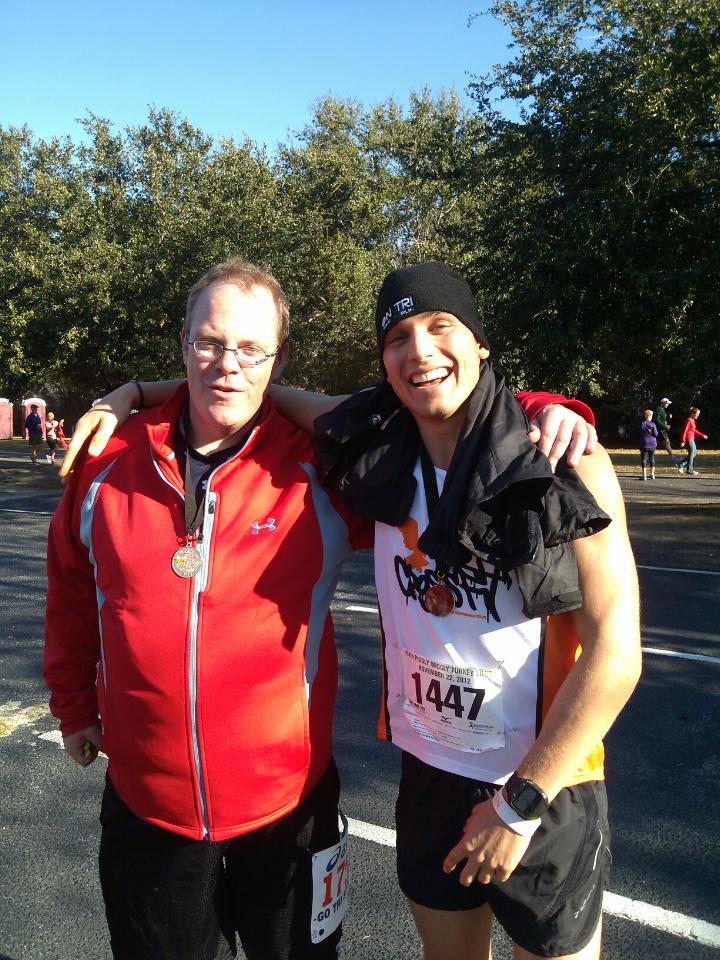
Oh the Turkey Trot, Thanksgiving tradition. Last year I was unable to race due to a stress fracture, but this year coming off Ironman I am feeling closer and closer to full potential. Not only is running the Turkey Trot Tradition, but so is finishing in 2nd Overall! This year was quite unique because I lost this race by literally 1second. Yes 1second photo finish kind of stuff. Unreal.
Race: Hilton Head Island Turkey Trot
Day: 11.22.2012 8am Start
Time: 36:29 (Pace 5:55)
1st Overall: 36:28
I am taking this one and learning from it because as a CFE athlete I shouldn't lose by a second. The fact of the matter is the 22year old Bates College (in Maine) Runner had me on this day. The HHI Turkey Trot finishes with all the 5K runners and there also happens to be a hard right into the finish line (about 150m to the line). I should have gotten on the inside edge or even surged earlier. The legs just didn't seem to have it. All and all though who can be ungrateful for a 2nd overall finish? and to be healthy? Not this guy.
Best race experience - had to be seeing one of my Hilton Head Health guys I have been training complete his first 5K running the whole entire way. I've been pushing Michael hard the last 4weeks and I truly think he's surprised himself with how much he's been able to do and how quickly he's improved. Straight up CrossFit style training coupled with a bunch of Fitness Classes and healthy eating this guy ended up finishing under 40minutes too!! Goes back to the ETA. Michaels effort and actions led to the terminal result on Thanksgiving Day.
I couldn't have been more pumped when I found Power Speed Endurance in my mailbox last week. I've quickly read thru the book front to back and would recommend it to all Endurance athletes, coaches and those in the Endurance community. Its for someone who is open to new perspective. In the past, I've struggled with Triathlon Training or Marathon Training type books because they sometimes take it over the top, get too wordy and are boring. One example of a book of that sort was the "Triathletes Bible" (I think there's like 20 editions now or something) Anyways, I found myself quite overwhelmed. Power Speed Endurance is a heck of a lot different. In a good way.
Power Speed Endurance not only takes a completely different approach on Endurance training, but the books lays it out where it should flat out make sense to the every triathlete. The book is backed up by science and focuses on strength and conditioning as and the skill within the sports. CrossFit Endurance is sometimes quite difficult to explain to the typical LSD Endurance athlete, but this book simplifies it.The book is setup focusing on all sections of SKILL which include running, cycling, swimming, strength and conditioning and mobility. The mobility section is gold. I think it will blow the minds of people who aren't currently using bands, lacrosse balls or PVC rollers. Most athletes.
In the Endurance community skill is often overlooked so I was pumped to see that it was the heart of the focus in this book! The end of book breaks down valuable nutrition protocols and then finishes with the implementation of CrossFit Endurance training. So what did I like most?
Obviously I am into this stuff. I knew most of the material before reading. I mean this is the way I train, teach and program, but this book is now my number one go to resource. What I like most is now I have a tangible resource for training. I've gathered new ideas for team workouts and for my personal triathlon training. I didn't have a huge knowledge of swim technique, but Chris Michelmore's description in the book helps a ton. How can you argue with a book that within each section has an expert leading the discussion? This is a MUST for any Endurance coach because the case studies will help reinforce target training with your athletes.
That said, it's time for you to pull the trigger on a purchase. The pictures, descriptions of skill, drills, workouts and information provided is absolutely invaluable. You'll learn a lot and understand why this method of training truly works. If these posts regarding my training and all the Team Less Miles More CrossFit PRs aren't enough to convince you then this book will do the trick!
Like anything in life it's all about TESTING. If you've been debating taking the plunge, now you've got no excuses, Power Speed Endurance is on the market ... GO TEST!!